'Weak pelvic floor' is a phrase many people hear after childbirth, around menopause, following prostate surgery or when bladder symptoms begin. But pelvic-floor function is more sophisticated than a simple strong-versus-weak label.
Your pelvic floor needs enough strength to generate support, enough endurance to keep working when required, enough speed to respond to sudden pressure, good coordination with breathing and movement — and the ability to relax fully afterwards.
So when symptoms appear, the better question is not always 'How weak is my pelvic floor?' but 'What does my pelvic floor need to do better?'
In this resource
- What do we mean by pelvic-floor strength?
- What symptoms can occur when support or control is reduced?
- Why can pelvic-floor function change?
- Weak does not always mean 'squeeze harder'
- Can a pelvic floor be tight and still feel weak?
- Strength, endurance and quick responses all have different jobs
- How do I know what my pelvic floor needs?
- Pelvic-floor training is a process
- Breathing and whole-body coordination
- Bowel health matters
- Could the pelvic health chair support a weak or difficult-to-activate pelvic floor?
- When might some extra support be useful?
- Essential Bodyworks takeaway
- Explore related resources
What do we mean by pelvic-floor strength?
Strength is the ability of the pelvic-floor muscles to produce force. That matters, but everyday pelvic health also depends on endurance, repeated control, timing and coordination.
For example, your pelvic floor may need a quick response when you sneeze, sustained support during activity, coordinated control while lifting, and a complete release when you empty your bladder or bowel.
What symptoms can occur when support or control is reduced?
Possible symptoms can include urine leakage during coughing, sneezing, laughing, lifting or exercise; difficulty controlling wind or stool; a feeling of reduced pelvic support; and, in some people, symptoms associated with pelvic organ prolapse.
Men may particularly notice leakage following prostate surgery. Women may first become aware of symptoms during or after pregnancy, around menopause or after pelvic surgery.
Symptoms alone cannot tell you exactly what the muscles are doing. Urgency, discomfort, incomplete emptying and other pelvic symptoms can have different causes and can also occur when the pelvic floor is overactive or poorly coordinated. That is why understanding the pattern matters more than automatically adding more squeezing.
Why can pelvic-floor function change?
Pelvic-floor function can be influenced by pregnancy and childbirth, menopause, pelvic or prostate surgery, repeated constipation and straining, chronic coughing, ageing and other individual health factors.
These influences do not mean that pelvic-floor problems are inevitable. Pelvic-floor function is adaptable, and awareness, good technique, movement and appropriate support can all help people work towards better control and confidence.
Weak does not always mean 'squeeze harder'
A harder contraction is not automatically a better contraction. If the wrong muscles are doing most of the work, you are holding your breath, bearing down rather than lifting, or never fully releasing between contractions, simply adding more repetitions may reinforce an unhelpful pattern.
Good pelvic-floor training starts with awareness and technique. From there, the programme can develop strength, endurance, quicker responses and functional control according to the person's symptoms and goals.
Can a pelvic floor be tight and still feel weak?
Yes. A muscle that spends too much time held in a shortened or tense state may have difficulty producing an effective, well-coordinated contraction when it is actually needed. This is one reason pelvic-floor dysfunction can involve both reduced function and excessive muscle activity.
Clues that relaxation or overactivity may need attention include pelvic or perineal pain, pain with penetration, persistent gripping, difficulty relaxing to empty the bladder or bowel, or exercises that increase discomfort.
If those features are part of your picture, more strengthening is not automatically the best starting point. Our Pelvic-Floor Overactivity & Relaxation resource explains why learning to soften and coordinate the muscles can sometimes be just as important as building strength.
Strength, endurance and quick responses all have different jobs
Think of the pelvic floor as a responsive support system rather than an on/off switch. It needs to adapt to different demands.
Strength helps generate an effective contraction.
Endurance helps maintain support when needed.
Quick responses help prepare for sudden pressure such as coughing or sneezing.
Coordination helps the pelvic floor work with breathing, the abdominal wall and movement.
Relaxation allows the muscles to return to rest and helps normal bladder, bowel and sexual function.
How do I know what my pelvic floor needs?
Start with the core education in our 'How Do I Find & Exercise My Pelvic Floor?' resource. Notice whether you can identify a gentle lift, continue breathing and then completely let the muscles go.
If the movement is difficult to find, or you are unsure whether you can both contract and relax, additional guidance can help you understand your starting point. The aim is not to label the pelvic floor as simply 'weak' but to identify what it needs to do more effectively.
Pelvic-floor training is a process
Pelvic-floor training works best as a progressive skill rather than a race to complete a particular number of squeezes. Building awareness, technique, strength, endurance and quicker responses takes practice, and the right pace will vary between individuals.
Progress can show up in different ways: fewer leaks, better control during activity, greater confidence, improved endurance, an easier-to-find contraction or simply feeling more connected with the muscles. These functional changes matter.
Breathing and whole-body coordination
The pelvic floor works alongside the diaphragm and abdominal wall. Repeated breath-holding and unnecessary bracing can change the way pressure is managed through the trunk.
Bowel health matters
Repeated constipation and straining can increase pressure through the pelvic floor, so comfortable bowel habits are part of the wider support picture. Fluids, fluid-rich foods, fibre, movement and a relaxed toileting position can all contribute.
A simple toilet position can reduce unnecessary straining
Sit fully on the toilet rather than hovering. Place your feet on a small foot stool so your knees are above your hips, lean slightly forwards with your forearms resting on your thighs, allow your abdomen and pelvic floor to soften, and breathe normally. The aim is to create a comfortable position for bowel emptying rather than pushing or forcing.
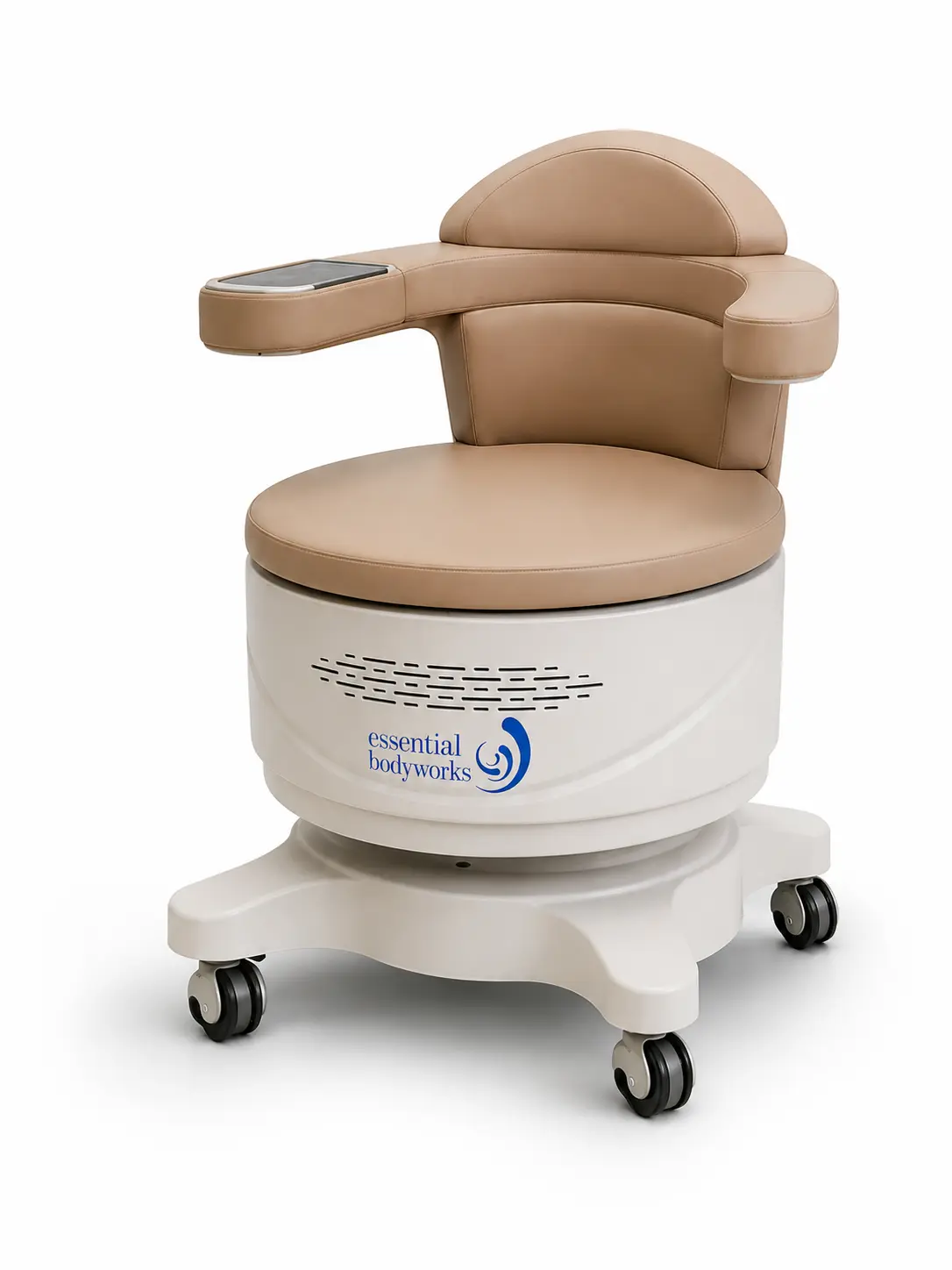
Could the pelvic health chair support a weak or difficult-to-activate pelvic floor?
For appropriately screened clients with pelvic-floor weakness or difficulty activating the muscles, the Essential Bodyworks pelvic health chair is a particularly relevant option to explore. Treatment is non-invasive and fully clothed, using pelvic-floor stimulation while you sit comfortably.
The chair can provide additional muscle activation while a client is also developing awareness, voluntary control, breathing and functional use. It is not necessary to treat it as something that can only be considered after a person has 'failed' exercises; where the presentation is suitable, it can form part of the support plan from the outset.
Not every pelvic-floor presentation needs more stimulation. If pain, significant gripping or difficulty relaxing is the main pattern, the priority may be relaxation and different support. Essential Bodyworks therefore uses pre-treatment screening, symptom pattern, contraindications and current manufacturer/clinic guidance to decide whether chair treatment is appropriate.
When might some extra support be useful?
Extra support can be useful if you cannot clearly identify the muscles, struggle to relax them, symptoms are affecting your confidence, or regular self-directed exercises do not seem to be changing the way your pelvic floor functions. The aim is to choose support that fits your pattern rather than simply doing more repetitions.
If something clearly falls outside the Essential Bodyworks scope, we will explain that and signpost appropriately. Where you are already receiving medical or pelvic-health care, Essential Bodyworks support can sit alongside it.
Essential Bodyworks takeaway
Pelvic-floor health is not a competition to create the strongest possible squeeze. The goal is a pelvic floor that can respond when you need it, sustain support when required, coordinate with the rest of your body and relax when its work is done.
That is why our Pelvic Health Hub looks beyond the word 'weakness' and helps you understand the whole pattern before deciding what kind of support may be appropriate.
Explore related resources
- How Do I Find & Exercise My Pelvic Floor?
- Pelvic-Floor Overactivity & Relaxation
- Why Do I Leak When I Cough or Sneeze?
- Urinary Urgency & Frequency
- Prolapse, Heaviness & Pelvic Pressure
- Constipation, Bowel Health & Your Pelvic Floor
- Pelvic-Floor Recovery Before & After Prostate Surgery
- Postnatal Pelvic Health & Recovery
- Pelvic Health Through Perimenopause, Menopause & Beyond
Pelvic Health Chair Treatment
Non-invasive, fully clothed pelvic-floor support for suitable, screened clients.
This page provides general pelvic-floor and wellbeing education. Essential Bodyworks focuses on pelvic-floor awareness, breathing, bowel wellbeing, movement and appropriately screened support options. Pelvic-floor needs and responses vary; where something falls outside our scope, we will signpost appropriately.
pelvic health. whole body care. lasting confidence.
© Essential Bodyworks. All rights reserved.