Many people are told to 'do pelvic-floor exercises' without ever being shown where the muscles are or what they should feel. The pelvic floor is a group of muscles and connective tissues forming a supportive base at the bottom of the pelvis. It contributes to bladder and bowel control, pelvic-organ support, sexual function and pressure management during movement.
Good pelvic-floor function is not just about strength. The muscles need to contract, hold, respond quickly when needed — and then fully relax.
In this resource
- Where is my pelvic floor?
- What should a contraction feel like?
- Just as important: can you let go?
- Why we are including the 'tight pelvic floor' message
- Slow control and quicker responses
- Which position should I use?
- Breathe — don't brace
- Use the pelvic floor in real life
- Should I stop my urine to check the muscles?
- What if I cannot feel a contraction?
- Could the pelvic health chair help you connect with your pelvic floor?
- When might some extra support be useful?
- Explore related resources
Where is my pelvic floor?
In women, the pelvic floor surrounds the openings of the urethra, vagina and anus. In men, it supports the bladder and bowel and surrounds the urethral and anal regions beneath the pelvis. The muscles span the base of the pelvis rather like a supportive hammock or muscular sling.
What should a contraction feel like?
A pelvic-floor contraction is usually described as a gentle closing and lifting sensation around the pelvic openings — as though the muscles are drawing inward and upward rather than pushing down.
Try to keep breathing normally. Your buttocks, thighs and abdominal wall should not need to perform a large, forceful squeeze. The movement may feel subtle, particularly at first.
For men, useful cues can include a gentle lift around the back passage and base of the penis. For women, the sensation may feel like closing around the back passage and vaginal opening and gently lifting internally.
These are awareness cues rather than a test you have to pass. If the movement feels difficult to find, start with curiosity rather than forcing a harder squeeze. Additional support can help you explore what your pelvic floor is doing.
Just as important: can you let go?
After each contraction, allow the pelvic floor to soften and return fully to its resting position. A muscle that is constantly held or 'gripped' may not coordinate well, even if it feels strong.
Some people have difficulty letting the pelvic floor fully soften or may notice a pattern of persistent gripping. This can sometimes sit alongside pelvic or perineal discomfort, urinary urgency, bowel-emptying difficulty or discomfort during intimacy, although these symptoms can have different causes.
If this sounds familiar, more squeezing is not automatically the answer. Awareness, breathing, relaxation and coordination may be just as important as strengthening.
Why we are including the 'tight pelvic floor' message
The Buff Muff Method is one of the pelvic-health resources that reinforces a useful principle also reflected throughout this Hub: symptoms are not always explained by weakness, and some people benefit from learning to reduce unnecessary gripping and coordinate breathing and relaxation before simply adding more strengthening.
Slow control and quicker responses
Pelvic-floor muscles have to perform different jobs. They may need sustained control for everyday support and quicker responses when pressure rises suddenly, such as during a cough, sneeze or lift.
Rather than giving everybody the same fixed number of repetitions, focus on quality first: can you find the muscles, breathe comfortably, create a gentle lift, control it and then fully let go? From there, training can progress according to your starting point and goals.
Which position should I use?
Pelvic-floor awareness can be practised in different positions, including lying, sitting and standing. An easier position may help you learn the movement initially, while standing and functional positions become important because the pelvic floor ultimately needs to work during everyday life.
There is no need to make an inverted position a standard requirement. Position can be adapted to the individual, and the priority is a comfortable, correctly coordinated contraction and relaxation.
Breathe — don't brace
The pelvic floor works with the diaphragm and abdominal wall. Try not to hold your breath or create a large abdominal brace while learning the movement. Breathing comfortably can make it easier to notice both the lift of a contraction and the release that follows.
Your pelvic floor works alongside your breathing muscles and abdominal wall. Learning to gently contract and fully relax your pelvic floor, while breathing comfortably, can help you build awareness and coordination. More effort is not always better, and pelvic-floor exercises should be suited to your individual needs.
Use the pelvic floor in real life
Pelvic-floor training becomes most useful when control transfers into daily activity. For someone with stress leakage, for example, learning to gently prepare the pelvic floor before a predictable cough, sneeze or lift may be helpful.
Exercise should then progress according to the person's symptoms and goals — whether that means walking, gardening, returning to sport, lifting, postnatal recovery or rehabilitation after prostate treatment.
Should I stop my urine to check the muscles?
Trying to stop urine flow may sometimes help someone recognise the general muscle action, but repeatedly interrupting urination should not become the exercise itself. Pelvic-floor training is better practised away from the toilet.
What if I cannot feel a contraction?
If you cannot clearly feel a contraction, that does not mean you have failed or that you should simply squeeze harder. Sometimes a different cue, position or breathing strategy makes the movement easier to recognise. Where more individual guidance is needed, an appropriately qualified pelvic-health professional can help clarify technique.
For some people, additional feedback or stimulation may also be useful when voluntary activation is difficult. The important point is that any additional support should help build awareness and useful function rather than replace your own connection with the muscles.
Could the pelvic health chair help you connect with your pelvic floor?
For an appropriately screened client who has difficulty activating the pelvic floor, the Essential Bodyworks pelvic health chair is a positive additional option worth exploring. Treatment is non-invasive and fully clothed, using pelvic-floor stimulation while you sit comfortably.
The chair can sit alongside active pelvic-floor learning. The wider goal remains better awareness, voluntary control, appropriate strength and endurance, full relaxation and the ability to use the pelvic floor confidently during everyday movement. It is not about becoming dependent on passive treatment.
Screening matters because not every pelvic floor needs more stimulation. Where pain, significant overactivity or difficulty relaxing is the main pattern, the priority may be relaxation and individual guidance rather than strengthening. Chair suitability is therefore considered through the Essential Bodyworks pre-treatment questionnaire, symptom pattern, contraindication screening and current manufacturer/clinic guidance.
When might some extra support be useful?
Extra support can be useful if you cannot identify the muscles, exercises repeatedly feel uncomfortable, you struggle to relax after a contraction, or bladder, bowel, heaviness or pelvic symptoms are affecting your confidence. The aim is to find the support that fits your pattern rather than assuming everyone needs the same exercise programme.
If something clearly falls outside the Essential Bodyworks scope, we will explain that and signpost appropriately. Where you are already receiving medical or pelvic-health care, Essential Bodyworks support can sit alongside it.
Explore related resources
- Pelvic-Floor Weakness: What Does It Really Mean?
- Pelvic-Floor Overactivity & Relaxation
- Why Do I Leak When I Cough or Sneeze?
- Urinary Urgency & Frequency
- Why Am I Getting Up at Night to Urinate?
- Constipation, Bowel Health & Your Pelvic Floor
- Pelvic-Floor Recovery Before & After Prostate Surgery
- Postnatal Pelvic Health & Recovery
- Pelvic Health Through Perimenopause, Menopause & Beyond
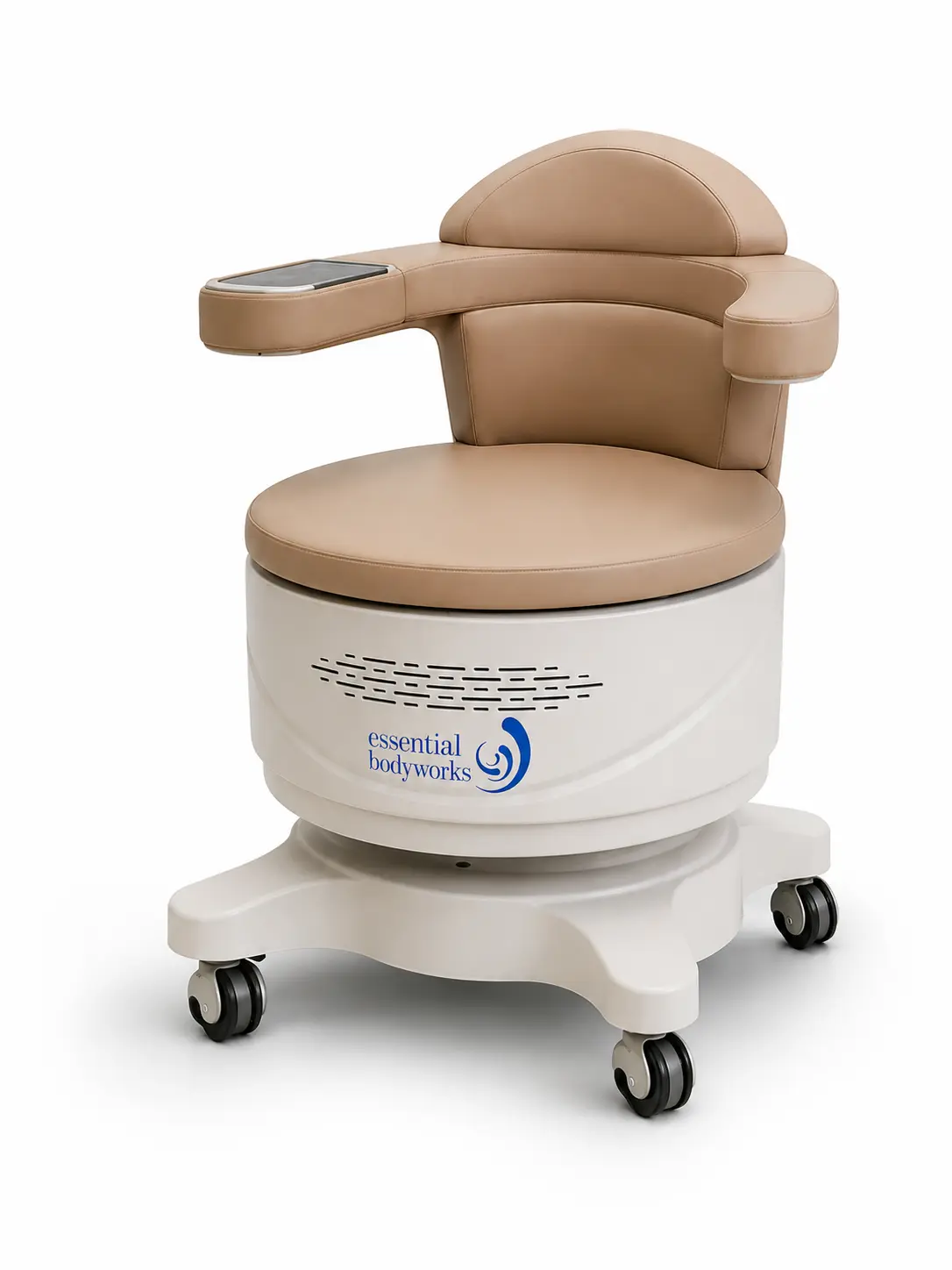
Pelvic Health Chair Treatment
Chair treatment may be considered as a secondary option where pelvic-floor activation is difficult.
This page provides general pelvic-floor and wellbeing education. Essential Bodyworks focuses on pelvic-floor awareness, breathing, relaxation, functional movement and appropriately screened support options. Pelvic-floor needs vary; where something falls outside our scope, we will signpost appropriately.
pelvic health. whole body care. lasting confidence.
© Essential Bodyworks. All rights reserved.